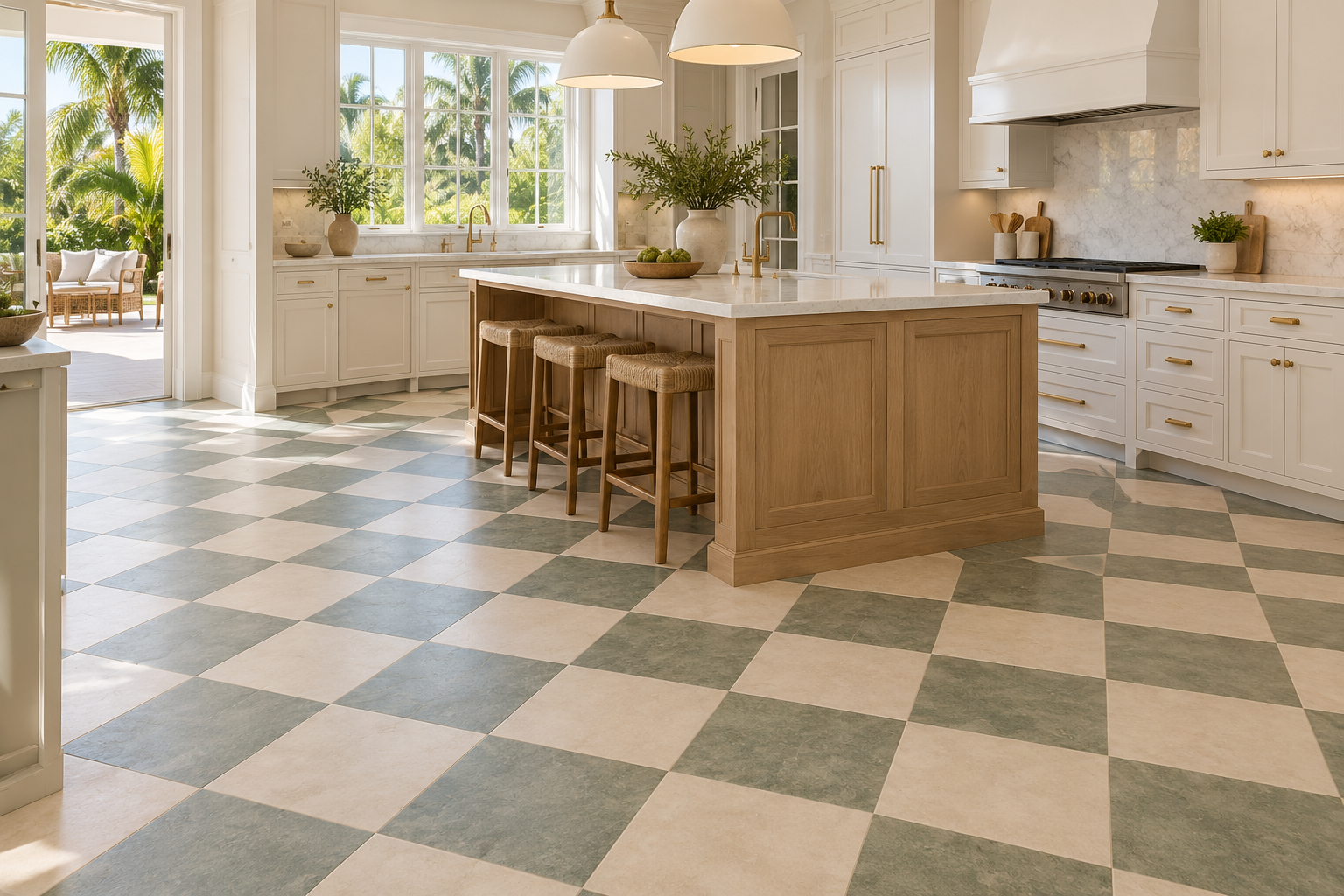
One of the strongest flooring trends in Florida for 2026 is not simply a color or a tile size.
It is continuity.
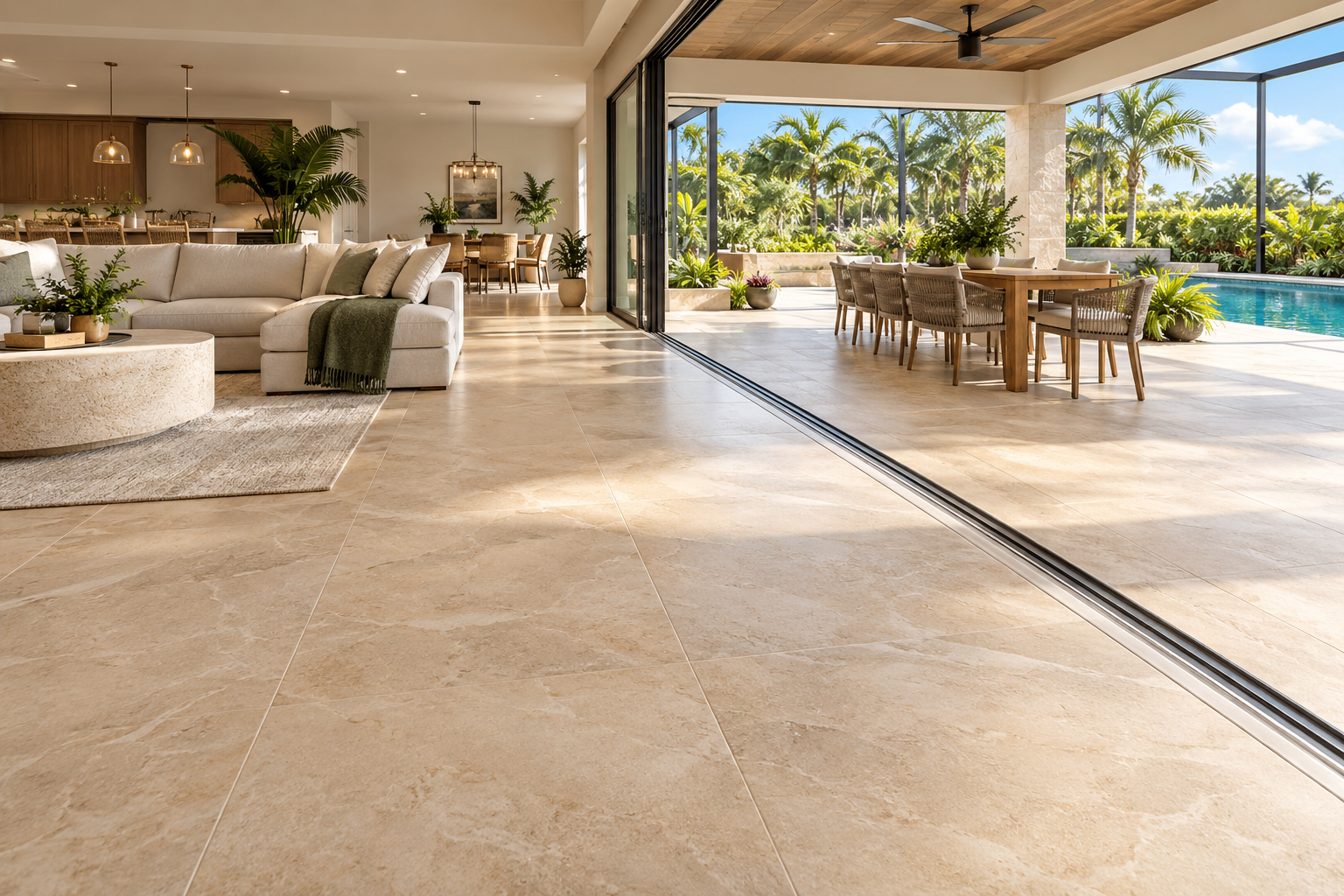
Homeowners are increasingly looking for ways to make the living room, kitchen and covered lanai feel like one connected space instead of three separate zones. Large sliding doors, oversized openings and outdoor living areas have made flooring part of the architectural transition between indoors and outdoors.
That is why large-format porcelain tile is becoming such a strong fit for Florida homes.
But creating a seamless indoor-outdoor look is not as simple as choosing one tile and installing it everywhere.
The real questions are:
- Can the same porcelain tile be used indoors and outdoors?
- Does the exterior area need a different finish?
- What slip resistance should you look for?
- How do drainage and slope affect the installation?
- Can a 24×48 tile work on a lanai?
- How do you minimize the threshold between the living room and patio?
Here is what Florida homeowners, builders and contractors should know before specifying an indoor-outdoor porcelain system.
Why Indoor-Outdoor Flooring Is Trending in Florida
Florida homes are designed around outdoor living more than homes in many other parts of the country.
Covered lanais, screened patios, pools, outdoor kitchens and large sliding-glass openings are common features across Orlando, Tampa, Sarasota, Naples, Fort Myers and South Florida.
When the flooring changes abruptly at the sliding door, the outdoor space can feel like an addition.
When the material, color and grout alignment continue visually through the opening, the lanai can feel like an extension of the living area.
That seamless effect is one reason warm stone-look porcelain, travertine-inspired porcelain and large-format 24×48 tile are becoming so popular.
Why Porcelain Works So Well for Florida Indoor-Outdoor Spaces
Porcelain tile has several characteristics that make it attractive for Florida homes.
Porcelain is a dense type of ceramic tile. Under ANSI standards, porcelain tile has water absorption of 0.5 percent or less.
That low absorption, combined with the right exterior rating, makes porcelain especially useful in spaces exposed to humidity, rain, pool splash and frequent indoor-outdoor traffic.
Other advantages include:
- Strong water resistance
- Excellent dimensional stability
- High resistance to UV-related visual change
- Easy cleaning
- Compatibility with concrete slabs
- Natural stone, wood and concrete visuals
- Large-format options with fewer grout lines
Can You Use the Exact Same Porcelain Tile Indoors and Outdoors?
Sometimes yes, but not automatically.
The most important rule is this:
The tile used outdoors must be specifically approved by the manufacturer for exterior use.
The Tile Council of North America recommends checking the manufacturer’s exterior-use guidance because exterior suitability depends on more than appearance. Water absorption, surface finish, freeze-thaw performance where relevant and other physical properties may all be considered.
In many product collections, manufacturers solve this by offering:
- An interior matte tile
- A matching exterior-textured version
- A thicker outdoor paver in the same visual
This allows the indoor and outdoor floors to look nearly identical while using the correct surface for each environment.
Why the Outdoor Finish Usually Needs More Texture
A polished or smooth interior porcelain may look beautiful in a living room but can be a poor choice on a lanai that sees rain, wet feet or pool splash.
Outdoor surfaces should be selected with traction in mind.
DCOF—Dynamic Coefficient of Friction—is one measurement used to evaluate hard-surface flooring traction. ANSI A326.3 provides a framework for DCOF testing and product-use classifications.
However, DCOF should not be treated as a single universal “safe or unsafe” number. The correct product depends on the expected conditions, including water exposure, slope, footwear and maintenance.
For a pool-adjacent or frequently wet lanai, a manufacturer-rated exterior or wet-area surface is usually a better choice than a standard indoor matte tile.
What About a Covered Lanai?
A covered lanai may be protected from direct rain, but it is still an exterior-adjacent environment.
Florida lanais can experience:
- Wind-driven rain
- Pool splash
- Wet feet
- High humidity
- Intense heat
- Sun exposure
- Sand and grit
Because of that, homeowners should not assume an interior-only tile is appropriate simply because the roof covers the patio.
Is 24×48 Porcelain Tile Good for a Florida Lanai?
It can be an excellent choice.
Large-format porcelain is attractive because fewer grout joints create a cleaner, more expansive look. A 24×48 format can visually connect a large living room to an equally generous lanai.
But large tile places greater demands on installation quality.
The substrate needs to be appropriately flat, and installers need to manage:
- Mortar coverage
- Lippage
- Tile warpage
- Grout-joint width
- Layout
- Movement accommodation
On an exterior slab, drainage and slope become even more important.
Drainage Is More Important Than the Tile
One of the biggest mistakes in outdoor tile installations is focusing entirely on the tile itself.
Even a high-quality porcelain tile will not fix a lanai slab that holds water.
Exterior tile systems must be designed so water can drain properly. The Tile Council of North America emphasizes the importance of proper slope and water management in exterior installations.
Standing water can create maintenance problems, increase slip concerns and place unnecessary stress on the installation system.
Does Outdoor Porcelain Tile Need Grout?
Yes, traditional installed porcelain tile generally uses grout joints.
The goal is not to eliminate grout completely. The goal is to use an appropriate joint width and grout color that supports the visual continuity of the installation.
Large-format tile helps because there are fewer grout lines across the same square footage.
For an indoor-outdoor installation, matching or coordinating grout color can make the transition feel even more seamless.
What About Movement Joints?
Movement accommodation is critical in tile installations, especially in Florida where exterior slabs can experience strong temperature changes and direct sunlight.
Movement joints allow the tile system to accommodate expansion and contraction without transferring all of that stress into the tile and grout.
These joints should never simply be eliminated because a homeowner wants a perfectly uninterrupted visual.
A good installer incorporates them strategically into the layout.
How Do You Make the Sliding-Door Threshold Look Seamless?
The cleanest indoor-outdoor floors are planned before installation begins.
Important factors include:
- Interior slab elevation
- Exterior slab elevation
- Door-track height
- Tile thickness
- Mortar-bed thickness
- Drainage slope
If these conditions are considered early, the finished transition can often be made very low-profile.
If they are ignored until tile installation starts, the project may end up with an awkward step or transition piece.
Can You Run Interior Tile Straight Onto a Pool Deck?
Only if the complete system and product are appropriate for that application.
Pool areas demand additional traction and water-management considerations.
A product that works perfectly in a living room may not provide the right surface for a pool deck.
Many manufacturers offer matching outdoor pavers or textured exterior finishes precisely for this reason.
Porcelain vs. LVP for Indoor-Outdoor Flooring
Inside the home, both porcelain and LVP can perform very well.
Outside, the comparison changes.
Most residential LVP products are designed for conditioned interior spaces. Intense heat, direct sunlight, rain and temperature extremes can exceed the manufacturer’s approved installation conditions.
For fully exterior or open-lanai applications, exterior-rated porcelain is generally the more reliable material.
If a Florida room or lanai is completely enclosed, conditioned and protected from the weather, certain LVP products may be suitable—but the exact manufacturer requirements must be checked.
Porcelain vs. Natural Travertine
Travertine remains popular in Florida outdoor design because of its warm natural appearance.
Porcelain can reproduce that look while offering:
- Lower water absorption
- Less routine sealing
- More consistent sizing
- Greater stain resistance
- Matching indoor and outdoor collections
Natural stone still offers authentic variation that porcelain cannot completely duplicate, so the decision comes down to maintenance preferences, budget and design priorities.
Why Warm Stone Looks Are Replacing Cold Gray
The indoor-outdoor porcelain trend is closely connected to the broader shift away from cool gray flooring.
Warm limestone, beige travertine, cream stone and sandy neutral visuals pair naturally with:
- White cabinetry
- Natural wood furniture
- Florida sunlight
- Pool environments
- Organic modern interiors
This allows one flooring palette to work across both indoor and outdoor spaces.
What Should Contractors Verify Before Ordering Tile?
Before specifying one collection for both environments, verify:
- Is the exact outdoor SKU rated for exterior use?
- What surface finish is recommended for wet areas?
- What does the manufacturer say about DCOF and use classification?
- Is there a matching interior version?
- Are both formats calibrated to compatible dimensions?
- What grout-joint width is recommended?
- What mortar is approved for exterior installation?
- How will the slab be sloped and drained?
- Where are movement joints required?
- Can the door threshold be coordinated with finished-floor elevations?
What About Florida Concrete Slabs?
Both interior and exterior porcelain installations depend on good substrate preparation.
Concrete should be evaluated for:
- Flatness
- Cracks
- Contamination
- Moisture conditions
- Drainage slope outdoors
Large-format tile does not hide an uneven slab. In many cases, it makes the problem more visible.
Is Indoor-Outdoor Porcelain Worth It?
For the right Florida home, it can dramatically change how the property feels.
The visual benefit is simple: the eye continues beyond the sliding doors instead of stopping at a flooring change.
That can make both the interior and the lanai feel larger and more connected.
But the best installations achieve the look by using technically appropriate products—not by forcing one interior tile into every environment.
Final Thought
The indoor-outdoor porcelain trend is not really about using one tile everywhere.
It is about creating one visual language across two very different environments.
The interior may need a comfortable matte surface. The lanai may need more texture, drainage and exterior-rated installation materials. The pool area may require still more traction.
When those components are selected from a coordinated collection, the finished space can look seamless without compromising performance.
At Green House Floors and More, we believe the best flooring decisions combine design with the real technical conditions of the Florida property—from the living room slab to the lanai and pool deck.
Frequently Asked Questions
Can porcelain tile be used outside in Florida?
Yes, when the specific tile is approved by the manufacturer for exterior use and installed with an appropriate exterior system, drainage and slope.
Can I use the exact same tile inside and outside?
Sometimes. Many collections offer matching interior and exterior finishes. The outdoor version may have additional texture or a different thickness while maintaining the same visual.
Is porcelain slippery around a pool?
Some porcelain surfaces can be slippery when wet. Pool-adjacent areas should use products specifically rated by the manufacturer for wet exterior applications and appropriate traction.
Is 24×48 tile good for a lanai?
Yes, large-format 24×48 porcelain can create a clean, expansive look, but it requires proper slab preparation, mortar coverage, drainage and movement accommodation.
Does outdoor porcelain tile need grout?
Yes, conventionally installed porcelain tile uses grout joints. Large-format tile reduces the number of joints, and coordinated grout color can make them visually subtle.
Is porcelain better than LVP for a lanai?
For open or weather-exposed lanais, exterior-rated porcelain is generally more appropriate. Most LVP is designed for conditioned interior spaces unless the manufacturer specifically approves another use.