Terrazzo is having a major design comeback in Florida.
But this is not the small-chip, institutional-looking terrazzo many people remember from older schools, hospitals or mid-century buildings.
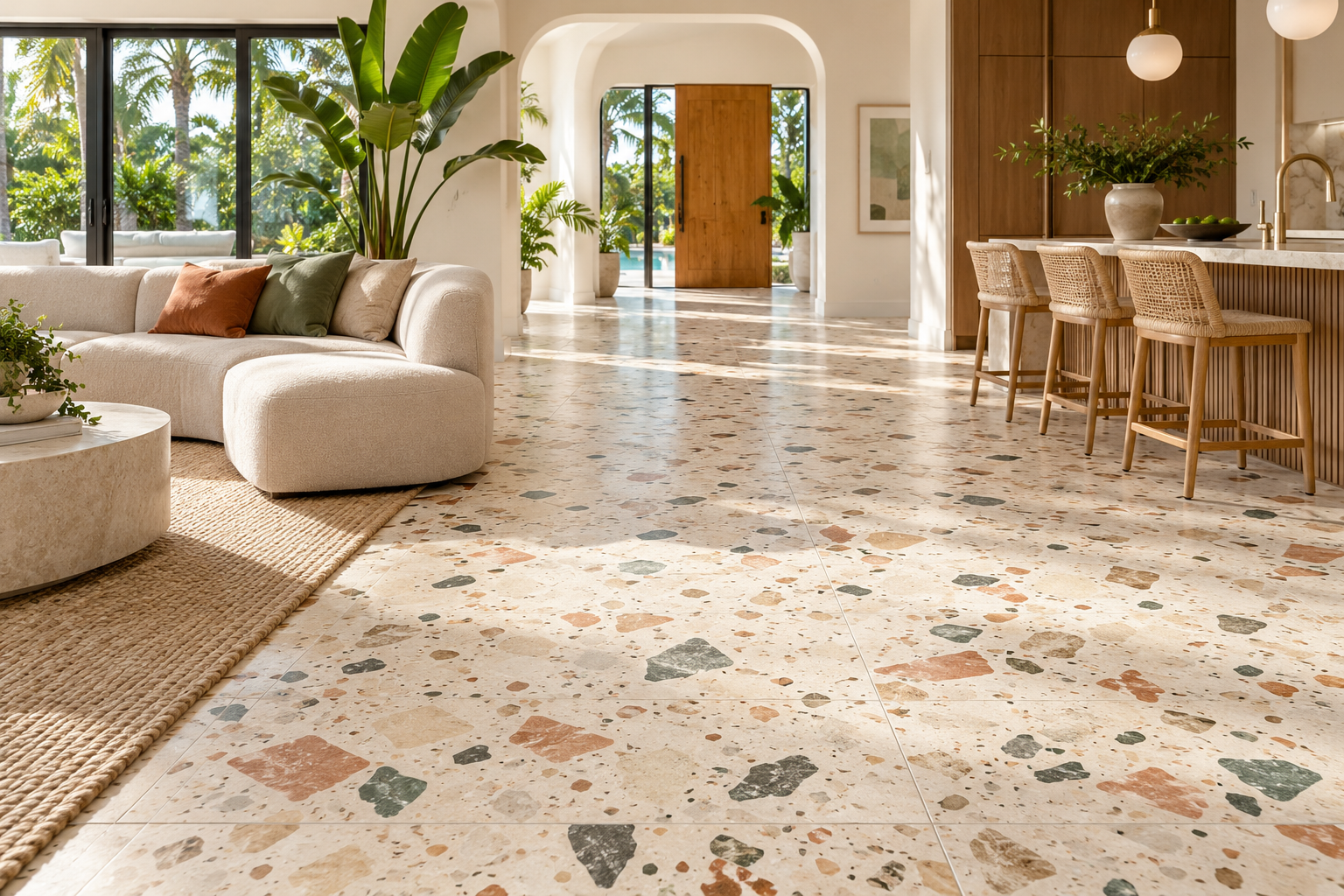
In 2026, terrazzo is returning in a much more refined way: warmer base colors, larger aggregate chips, softer natural tones and modern porcelain collections that recreate the terrazzo look with far less maintenance.
For Florida homeowners, builders and designers, that creates an important question:
Should you choose real terrazzo, restore original terrazzo, or install terrazzo-look porcelain?
The answer depends on the property, budget, slab condition, design goal and how much maintenance you are willing to take on.
Why Terrazzo Is Trending Again in Florida
Terrazzo has deep roots in Florida design, especially in Miami, Miami Beach and mid-century homes throughout the state.
Today’s revival is being driven by a few things at once:
- Warm natural palettes replacing cool gray interiors
- Interest in Florida and Miami architectural history
- Demand for durable, low-maintenance surfaces
- Large-format porcelain technology
- Designers looking for more character than plain concrete or wood-look flooring
- Homeowners restoring original mid-century materials instead of removing them
The look also works well with current Florida interiors because terrazzo pairs naturally with white walls, walnut cabinetry, warm oak, plaster finishes, curved furniture and tropical landscaping.
What Is Real Terrazzo?
Traditional terrazzo is a composite flooring material made by embedding chips of marble, quartz, granite, glass or other aggregates into a cementitious or resin-based binder.
After installation, the surface is ground and polished to expose the aggregate and create the finished look.
In many older Florida homes, terrazzo was installed directly over the concrete slab and can still be found underneath carpet, vinyl or other later flooring.
Why Original Florida Terrazzo Is Worth Investigating
If you own an older Florida home, especially one built in the 1950s, 1960s or 1970s, it may be worth checking what is underneath the existing flooring before deciding to install something new.
Original terrazzo can sometimes be restored through:
- Grinding
- Crack repair
- Patching
- Polishing
- Stain treatment
- Sealing
When restoration is successful, the result can be extremely durable and architecturally appropriate for the property.
What Is Terrazzo-Look Porcelain?
Terrazzo-look porcelain uses digital printing and surface texture to reproduce the appearance of terrazzo without using a poured terrazzo system.
Instead of being installed as a continuous poured floor, it is manufactured as porcelain tile.
Modern versions can reproduce:
- Large aggregate chips
- Fine micro-terrazzo
- Warm stone bases
- Muted terracotta accents
- Black-and-white contrast
- Green, beige and earth-tone chips
This makes terrazzo-look porcelain easier to specify in both residential and commercial projects.
Real Terrazzo vs. Terrazzo-Look Porcelain
Installation
Real terrazzo is a specialized installation. It requires trained professionals, careful substrate preparation and grinding or polishing equipment.
Terrazzo-look porcelain installs more like other porcelain tile, although large-format products still require experienced installers and a very flat substrate.
Cost
Real terrazzo usually has a higher installed cost because of labor, specialized materials and finishing.
Porcelain typically gives homeowners a lower entry cost while still delivering the terrazzo aesthetic.
Maintenance
Real cement-based terrazzo may require periodic sealing and professional maintenance depending on finish and use.
Porcelain is generally lower maintenance and does not require the same type of polishing or sealing routine as traditional terrazzo.
Repairs
Real terrazzo can often be patched, but matching the original aggregate and color can be difficult.
Porcelain tile can be replaced individually if spare tiles are available, although grout and dye-lot matching still matter.
Visual Continuity
Real terrazzo can create a nearly seamless surface with very few visible divisions.
Porcelain will always have grout joints, although large-format tile and matching grout can make those joints visually subtle.
Which Is Better for Florida Homes?
There is no universal winner.
Real terrazzo may be the better choice when:
- The home already has original terrazzo worth restoring
- The design calls for authentic mid-century or Miami character
- The budget supports specialized installation
- You want a long-term, highly durable surface
Terrazzo-look porcelain may be the better choice when:
- You want the terrazzo look with easier maintenance
- You are remodeling rather than restoring
- You want predictable color and pattern
- You need a practical material for bathrooms, kitchens or condos
- You want access to many sizes and finishes
Is Terrazzo Waterproof?
Real terrazzo is highly durable, but “waterproof” is not the most accurate way to describe every terrazzo system.
Cement-based terrazzo and grout-like materials can be porous and may require sealing depending on the system.
Porcelain tile, by contrast, has very low water absorption and is extremely well suited to wet Florida environments when installed correctly.
Is Terrazzo Good for Florida Concrete Slabs?
Yes, but the slab condition matters.
Florida homes frequently use concrete slab construction, and both terrazzo and porcelain depend on proper substrate preparation.
Before installation, contractors should evaluate:
- Cracks
- Moisture
- Flatness
- Contamination
- Previous adhesives or coatings
Ignoring slab issues can lead to cracking, bond failure or visible imperfections later.
Can Terrazzo Be Used in Bathrooms?
Yes.
Terrazzo and terrazzo-look porcelain can both work well in bathrooms, but surface finish and wet-area suitability must be considered.
A high-polish surface may not be ideal in areas where water is frequently present.
For showers and wet bathrooms, a matte or textured porcelain product specifically rated for the application is often the more practical choice.
Can Terrazzo Work in a Florida Kitchen?
Absolutely.
Terrazzo works especially well in kitchens because the pattern helps disguise minor dirt, crumbs and everyday wear better than a very uniform floor.
Porcelain also offers excellent stain resistance and easy cleaning, which makes it especially practical for busy kitchens.
Does Real Terrazzo Need to Be Sealed?
Many cement-based terrazzo floors benefit from sealing because the binder can absorb liquids and stains.
The specific maintenance schedule depends on the terrazzo system, finish and manufacturer recommendations.
Porcelain tile generally does not require sealing, although some cementitious grout products may.
Why Large Aggregate Terrazzo Looks More Current
One of the biggest differences between older terrazzo and today’s trend is chip size.
Modern terrazzo often uses larger aggregate pieces that create more visual movement and a stronger design statement.
Popular 2026 combinations include:
- Warm cream with terracotta and sage chips
- Beige with charcoal and stone aggregates
- Soft white with oversized neutral fragments
- Muted green with warm marble chips
The result feels more architectural and less institutional.
Why Terrazzo Fits Florida Design So Well
Terrazzo feels especially natural in Florida because it connects to the state’s architectural history while also working with contemporary interiors.
It complements:
- Art Deco-inspired spaces
- Mid-century modern homes
- Organic modern interiors
- Coastal design
- Miami tropical style
- Modern luxury condos
That flexibility is one reason the material is returning in both restoration projects and new construction.
Should You Restore Old Terrazzo or Cover It?
If original terrazzo is present, restoration should at least be evaluated before covering it permanently.
Questions to ask include:
- How extensive are the cracks?
- Are there large patches from previous plumbing work?
- Are there deep stains?
- Has the surface been damaged by adhesives?
- Can the existing color work with the renovation?
- What will restoration cost compared with new flooring?
Sometimes restoration creates the best result. In other cases, damage or patching makes new flooring more practical.
Is Terrazzo-Look Porcelain Cheaper Than Real Terrazzo?
In many projects, yes.
Terrazzo-look porcelain generally uses a more familiar tile installation process and does not require the grinding and polishing associated with poured terrazzo.
However, total project cost still depends on:
- Tile size
- Subfloor preparation
- Layout complexity
- Demolition
- Mortar and grout
- Installer experience
What About Condos?
Terrazzo-look porcelain can be an excellent condo material because it is durable, water resistant and visually distinctive.
However, Florida condo owners must also consider:
- HOA approval
- Sound-control requirements
- Acoustic underlayment systems
- Slab conditions
- Finished-floor height
A beautiful tile choice still needs to work within the building’s technical requirements.
What Size Terrazzo-Look Porcelain Is Best?
Large-format porcelain is especially effective for terrazzo visuals because fewer grout joints make the floor appear more continuous.
Popular formats include:
- 24×24
- 24×48
- Large-format slabs for walls and specialty applications
The larger the tile, the more important substrate flatness and installation skill become.
What Grout Color Works Best?
If the goal is to mimic real terrazzo, use a grout color that closely coordinates with the base color of the tile.
A highly contrasting grout line can make the installation read more clearly as tile.
A closely matched grout color creates a more seamless appearance.
What Should Contractors Check Before Ordering?
- Tile calibration and exact size
- Recommended grout width
- Wet-area suitability
- DCOF or manufacturer use classification
- Required mortar
- Substrate flatness
- Movement-joint requirements
- Shade variation rating
- Availability of replacement material
Final Thought
Terrazzo is returning because it offers something many flooring trends do not: a strong connection between Florida’s design history and modern interiors.
Real terrazzo delivers authenticity, continuity and longevity. Terrazzo-look porcelain delivers easier maintenance, predictable installation and more flexibility for remodeling.
The right choice depends on whether you are restoring a Florida classic or creating a new space inspired by that history.
At Green House Floors and More, we believe flooring should be selected not just for the trend, but for the property, slab conditions, installation requirements and long-term maintenance expectations.
Frequently Asked Questions
Is terrazzo good for Florida homes?
Yes. Terrazzo is durable, works well over concrete slabs and fits Florida’s architectural style. The specific system should still be selected based on moisture, finish and maintenance needs.
Is terrazzo waterproof?
Traditional cement-based terrazzo can be porous and may require sealing. Terrazzo-look porcelain has very low water absorption and is generally easier to maintain in wet environments.
Is terrazzo expensive?
Real terrazzo can be more expensive because it requires specialized installation and finishing. Terrazzo-look porcelain often provides a more budget-friendly way to achieve a similar visual.
Does terrazzo need to be sealed?
Many cement-based terrazzo floors benefit from sealing. Porcelain typically does not require sealing, although grout may depending on the product.
Can old Florida terrazzo be restored?
Often yes. Grinding, patching, polishing and sealing can restore many original terrazzo floors, but the final result depends on cracks, stains, previous repairs and adhesive damage.
Is terrazzo-look porcelain cheaper than real terrazzo?
In many cases, yes. It uses a more conventional tile installation process and avoids the grinding and polishing required for traditional poured terrazzo.
Can terrazzo go over a concrete slab?
Yes. Both real terrazzo and porcelain can be installed over concrete slabs when the substrate is properly prepared and evaluated for cracks, moisture and flatness.
Should I restore old terrazzo or replace it?
If the original floor is structurally sound and visually compatible with the renovation, restoration may be worthwhile. If it has extensive patches, deep damage or severe staining, replacement may be more practical.