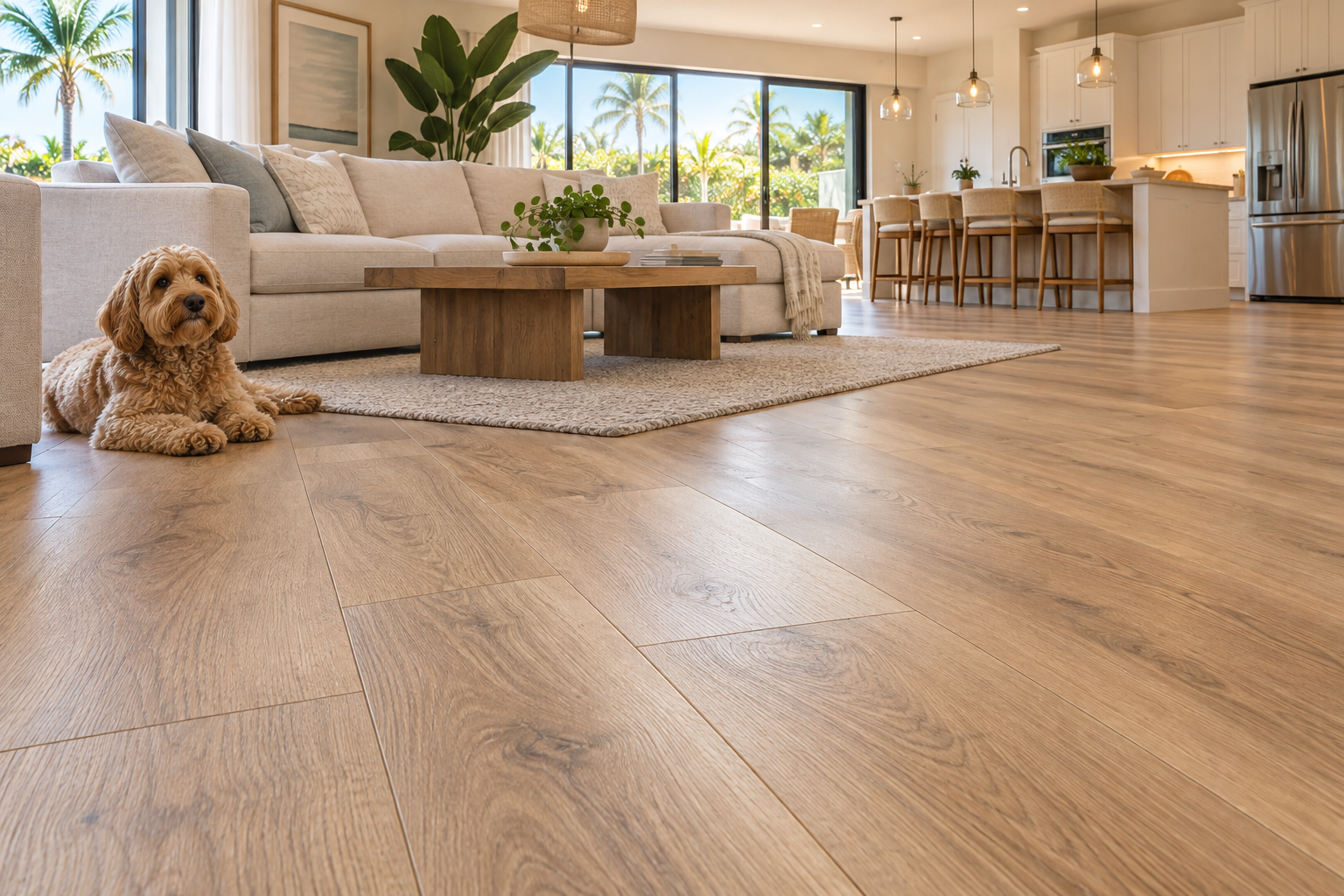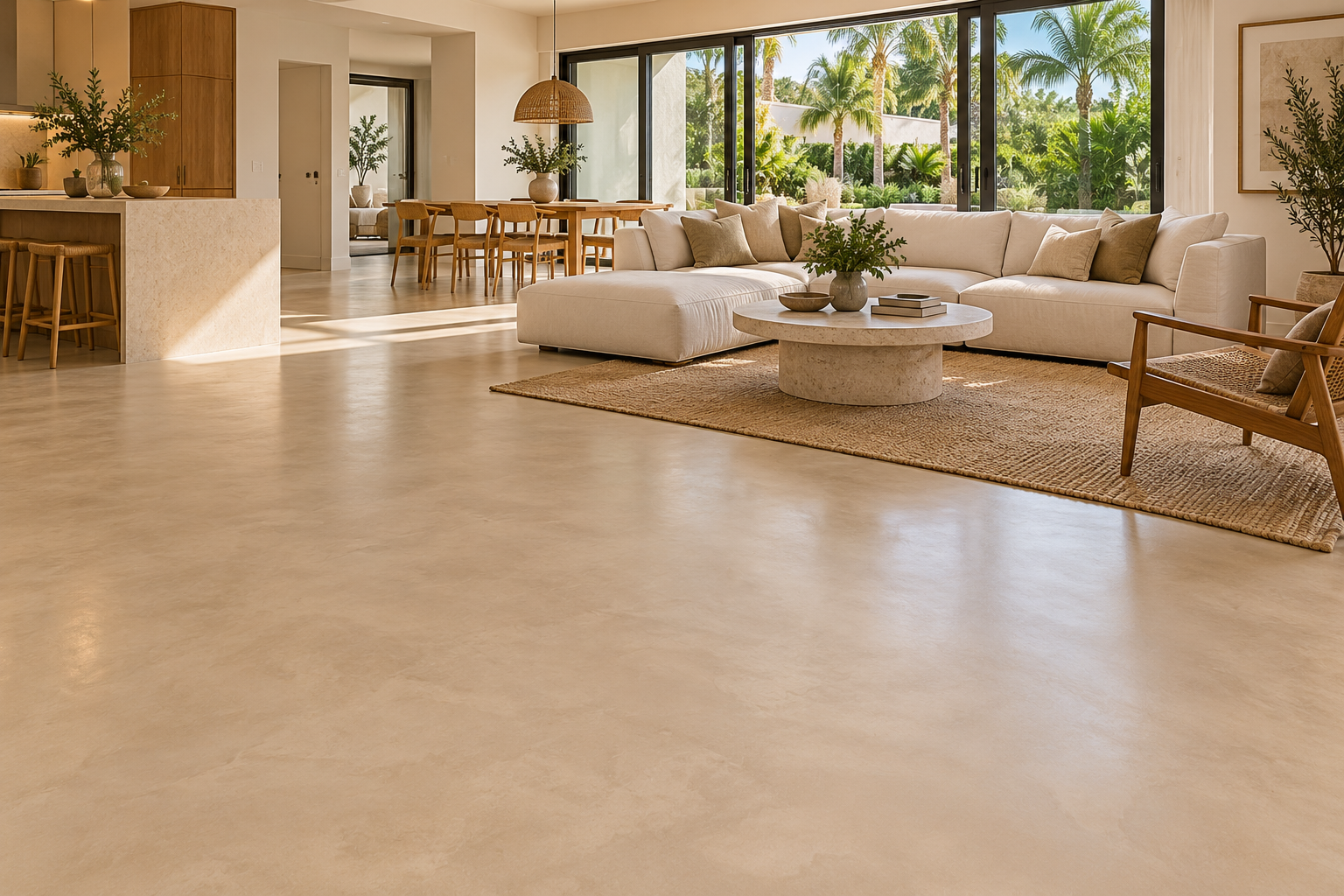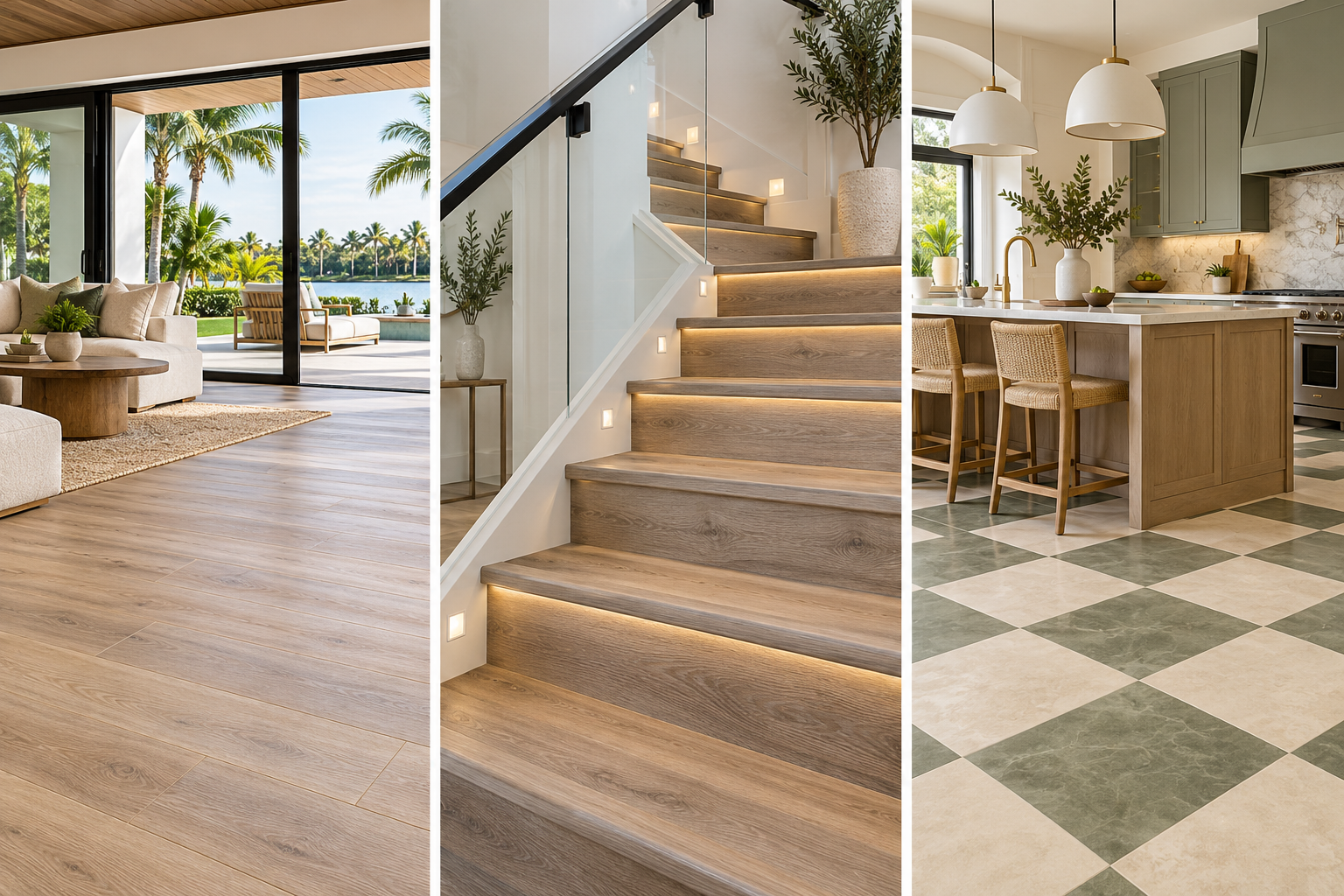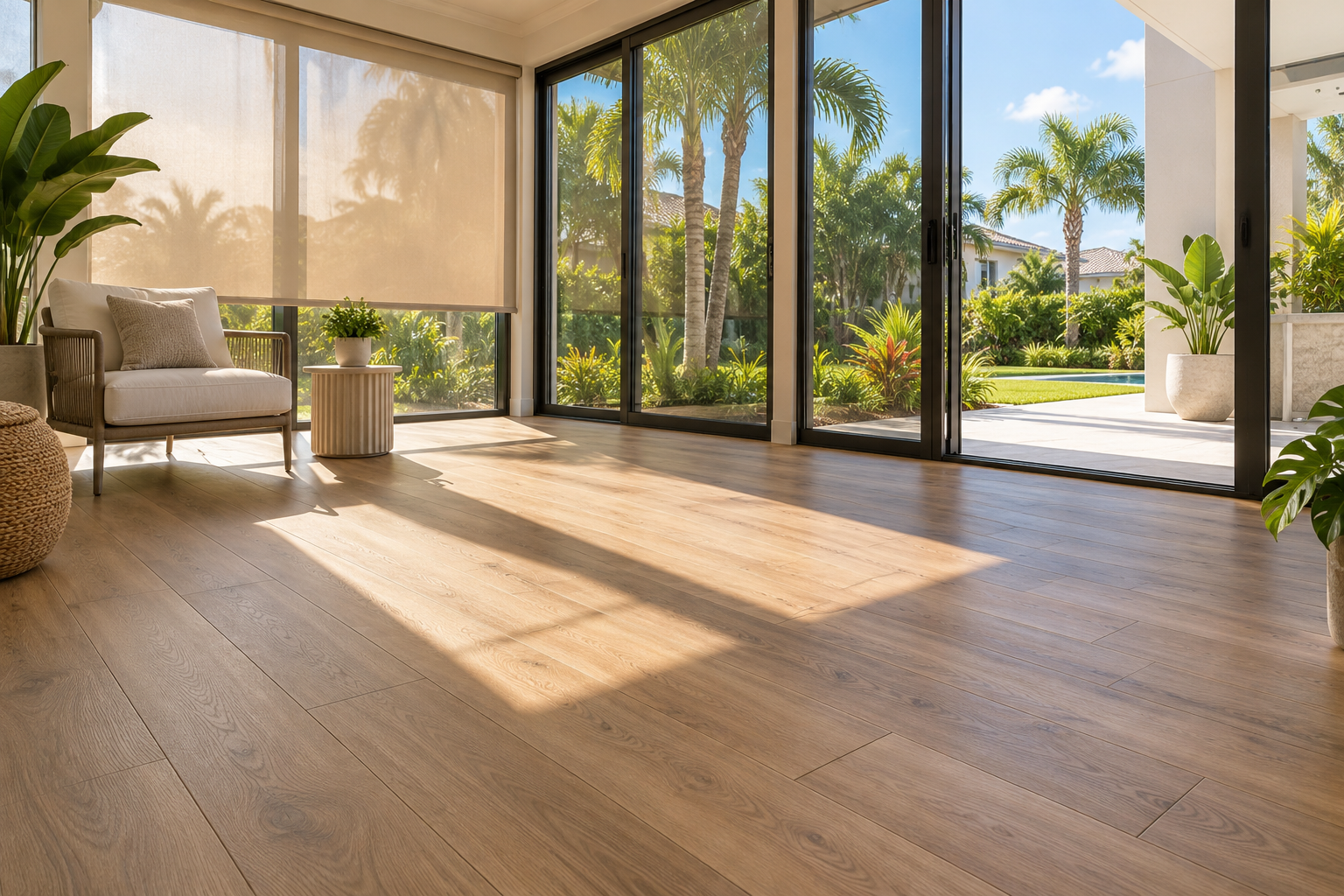
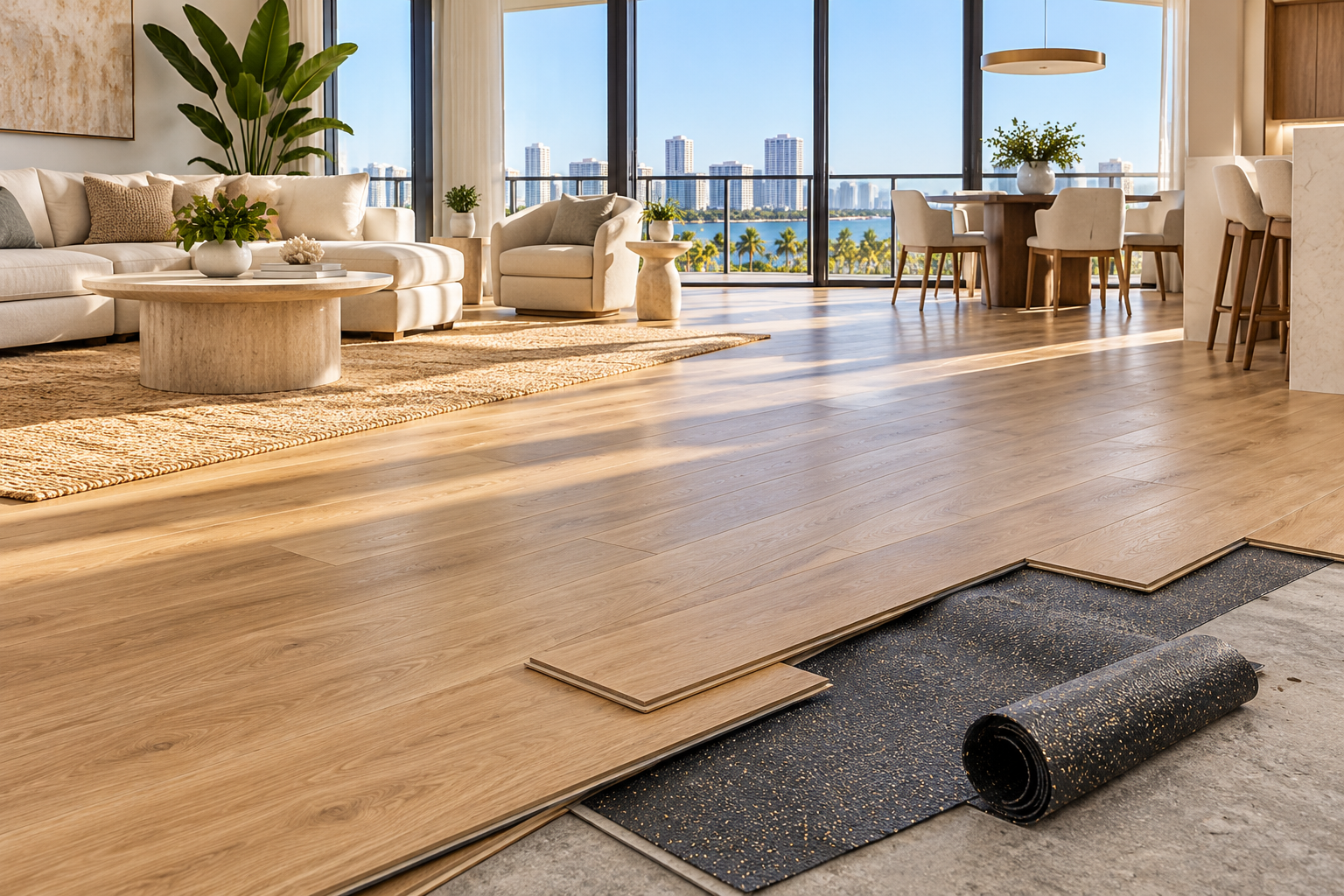
Replacing carpet with hard-surface flooring in a Florida condo is not just a design decision.
It is also an acoustic decision.
That is why condo owners often hear terms such as IIC, STC, Delta IIC, acoustic underlayment and HOA approval before a single plank or tile is installed.
The biggest mistake is assuming that a flooring box labeled “soundproof” or an underlayment advertised with a high IIC number automatically satisfies the building.
In most condo projects, the number that matters belongs to the tested floor-ceiling assembly, not to one product by itself.
What Sound Ratings Does Florida Use?
The Florida Building Code establishes sound-transmission requirements for assemblies separating dwelling units.
As a baseline, separating floor-ceiling assemblies are commonly required to achieve:
- STC 50 for airborne sound in laboratory testing
- IIC 50 for impact sound in laboratory testing
- 45 when the assembly is field tested
Your condo association may require more than that baseline.
Some Florida buildings require IIC 55, 60 or higher, specify an approved underlayment, or require a particular test report before the board signs off.
Your building documents control the approval process.
What Is IIC?
IIC stands for Impact Insulation Class.
It measures how effectively a floor-ceiling assembly reduces impact noise such as:
- Footsteps
- Dropped objects
- Chair movement
- Pet nails
For hard-surface flooring in a condo, IIC is usually one of the most important numbers because impact noise travels directly into the unit below.
What Is STC?
STC stands for Sound Transmission Class.
It measures airborne sound transmission such as:
- Voices
- Television
- Music
IIC and STC are not interchangeable. One addresses impact noise, while the other addresses airborne noise.
What Is Delta IIC?
Delta IIC measures the improvement created by a flooring or underlayment system compared with a reference assembly.
This can be useful when comparing acoustic products, but it still does not mean a single underlayment number will perform identically in every building.
The slab thickness, ceiling construction, flooring material and installation method all affect the final result.
Why the Whole Assembly Matters
Imagine two underlayments that both advertise excellent acoustic performance.
One test may have been performed over a thick concrete slab with a suspended ceiling below.
The other may have been tested over a completely different assembly.
If your condo has an exposed concrete ceiling below, the real-world performance can be very different.
That is why experienced condo boards increasingly ask for test reports that resemble the actual building construction.
What Flooring Is Best for Florida Condos?
SPC and Luxury Vinyl Plank
Rigid-core SPC and LVP are popular because they combine:
- Water resistance
- Easy maintenance
- Realistic wood visuals
- Relatively low profile
- Compatibility with acoustic underlayments
Some planks include an attached pad, but attached pad alone does not guarantee compliance with your condo’s sound requirements.
Engineered Hardwood
Engineered hardwood can work well in climate-controlled Florida condos and offers authentic real wood.
Depending on the product, it may be installed using acoustic adhesive or over an approved underlayment system.
The exact assembly must still be checked against the association’s requirements.
Porcelain Tile
Porcelain is extremely durable and practical in Florida, but hard tile surfaces transmit impact noise very efficiently without a proper sound-control system.
Condo tile installations often require an acoustic membrane beneath the tile in addition to crack-isolation or waterproofing requirements.
What Type of Underlayment Works Best?
There is no single best material for every condo.
Common acoustic underlayments include:
- Rubber
- Cork
- Dense recycled foam
- IXPE or EVA products
- Specialty sound-control membranes
The right choice depends on the flooring type, installation method, slab, building requirement and tested acoustic assembly.
Can You Add Extra Underlayment Under SPC?
Not always.
If an SPC plank already has attached pad, adding another layer beneath it may violate the manufacturer’s instructions.
Too much cushioning can allow excessive movement in the locking system and potentially lead to joint failure.
Always verify whether the flooring manufacturer permits additional underlayment.
What Should You Submit to Your Condo Association?
A typical condo flooring approval package may include:
- Flooring product specification sheet
- Underlayment specification sheet
- IIC/STC or Delta IIC test report
- Installation method
- Floor plan showing the renovation area
- Contractor license information
- Certificate of insurance
- Work schedule
- Elevator or loading-area reservation if required
Every building is different, so obtain the current architectural or alteration package before ordering material.
Should You Buy Flooring Before HOA Approval?
Usually, no.
A safer sequence is:
- Request the condo’s flooring rules
- Identify the minimum acoustic ratings
- Select the flooring and underlayment system
- Obtain the relevant test reports
- Submit the package
- Wait for written approval
- Then order material and schedule installation
This can prevent expensive restocking fees or a project delay.
What About Ground-Floor Condo Units?
Some associations relax acoustic requirements when no residential unit is located below.
Others apply the same flooring rules to every unit for consistency.
Do not assume a ground-floor unit is automatically exempt. Confirm it in writing.
Is Carpet Still the Quietest Option?
Carpet with padding generally performs very well for impact noise because the soft surface absorbs footsteps and other impacts.
This is why many older condo buildings were originally carpeted.
When carpet is replaced by tile, wood or rigid-core flooring, the acoustic assembly becomes much more important.
Does Floating Flooring Perform Better Than Glue-Down?
Not automatically.
A floating system may benefit from a dedicated acoustic underlayment.
A glue-down system may use a sound-rated adhesive or membrane.
The correct comparison is the tested acoustic performance of the complete assembly, not simply “floating versus glue-down.”
Why Florida Concrete Slabs Matter
Many Florida condos are built with concrete structural slabs.
Concrete provides mass that helps airborne-sound control, but impact noise can still travel through the structure.
The condition of the slab also matters for installation.
Before new flooring goes down, contractors should evaluate:
- Moisture
- Flatness
- Cracks
- Previous adhesives
- Surface contamination
Can a High IIC Number Be Misleading?
It can be misunderstood.
If an underlayment package advertises IIC 70, that does not mean your finished condo floor will automatically achieve IIC 70.
Ask:
- What slab was used in the test?
- Was there a suspended ceiling?
- What flooring was installed?
- What underlayment thickness was tested?
- Was the number IIC, STC or Delta IIC?
The closer the test assembly is to your building, the more useful the comparison becomes.
What Happens If You Install Without Approval?
Consequences depend on the condo documents, but they can include:
- Work stoppage
- Fines
- Noise complaints
- Required testing
- Removal of the new flooring
- Reinstallation using an approved system
That is why acoustic compliance should be handled before installation, not after a complaint.
How to Compare Two Acoustic Flooring Systems
When comparing products, do not focus on one marketing number.
Compare:
- The complete tested assembly
- Slab thickness in the test
- Ceiling construction
- IIC
- STC
- Delta IIC when available
- Underlayment thickness
- Flooring manufacturer compatibility
- Your condo association’s exact requirement
Final Thought
For Florida condo flooring, the best product is not simply the quietest plank or the thickest pad.
It is the flooring system your building will approve and that is tested for the conditions that actually matter.
At Green House Floors and More, we believe condo flooring should be selected as a complete system: flooring, acoustic layer, concrete slab, installation method and association requirements.
Frequently Asked Questions
What IIC rating is required for condo flooring in Florida?
The Florida Building Code baseline for separating floor-ceiling assemblies is commonly IIC 50 in laboratory testing, or 45 when field tested. Condo associations may require higher ratings.
What STC rating is required between Florida condo units?
The Florida Building Code baseline is commonly STC 50 for laboratory-tested separating assemblies, or 45 in field testing. Building rules may be stricter.
Does SPC flooring need acoustic underlayment in a condo?
Often yes, but the required system depends on the condo rules and flooring manufacturer. Some SPC includes attached pad, while other projects require a separate approved acoustic system.
Can I put extra underlayment under SPC with attached pad?
Only if the flooring manufacturer permits it. Extra cushioning can sometimes cause too much movement and damage the locking system.
What is the difference between IIC and STC?
IIC measures impact noise such as footsteps. STC measures airborne sound such as voices and television.
What is Delta IIC?
Delta IIC measures how much improvement a flooring or underlayment system adds compared with a reference assembly.
Do ground-floor condos need soundproof underlayment?
Requirements vary. Some associations exempt units without a residence below, while others enforce the same rules throughout the building.
Should I get HOA approval before buying flooring?
Yes. Obtain the current flooring requirements and written approval before ordering material whenever possible.
Sources
Florida Building Commission — Florida Building Code resources and sound-transmission guidance.
Flooring Institute — 2026 guidance on IIC, STC, Delta IIC and condo flooring assemblies.
Florida condo flooring approval guidance reviewed in 2026 from Florida flooring professionals and association-focused renovation resources.