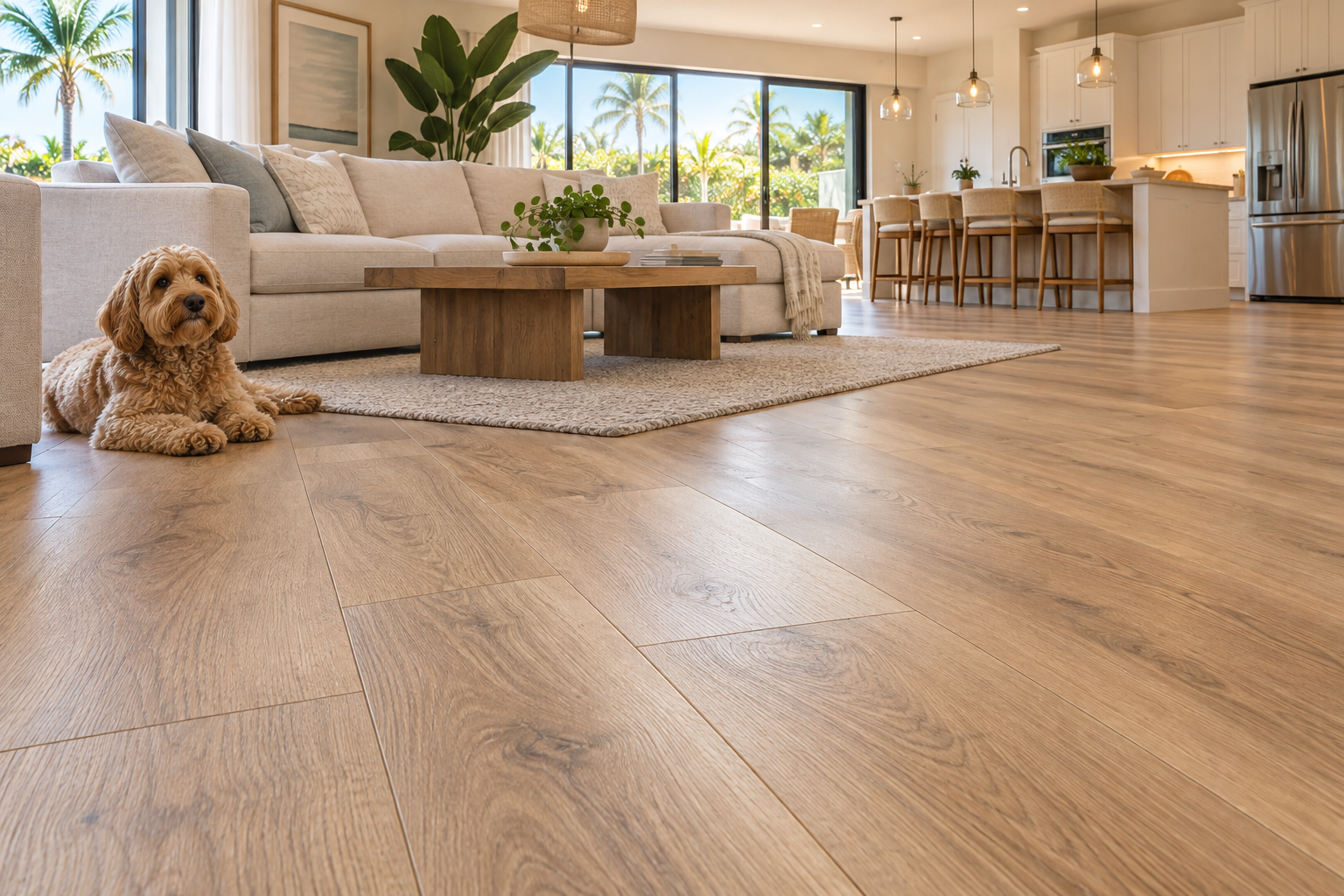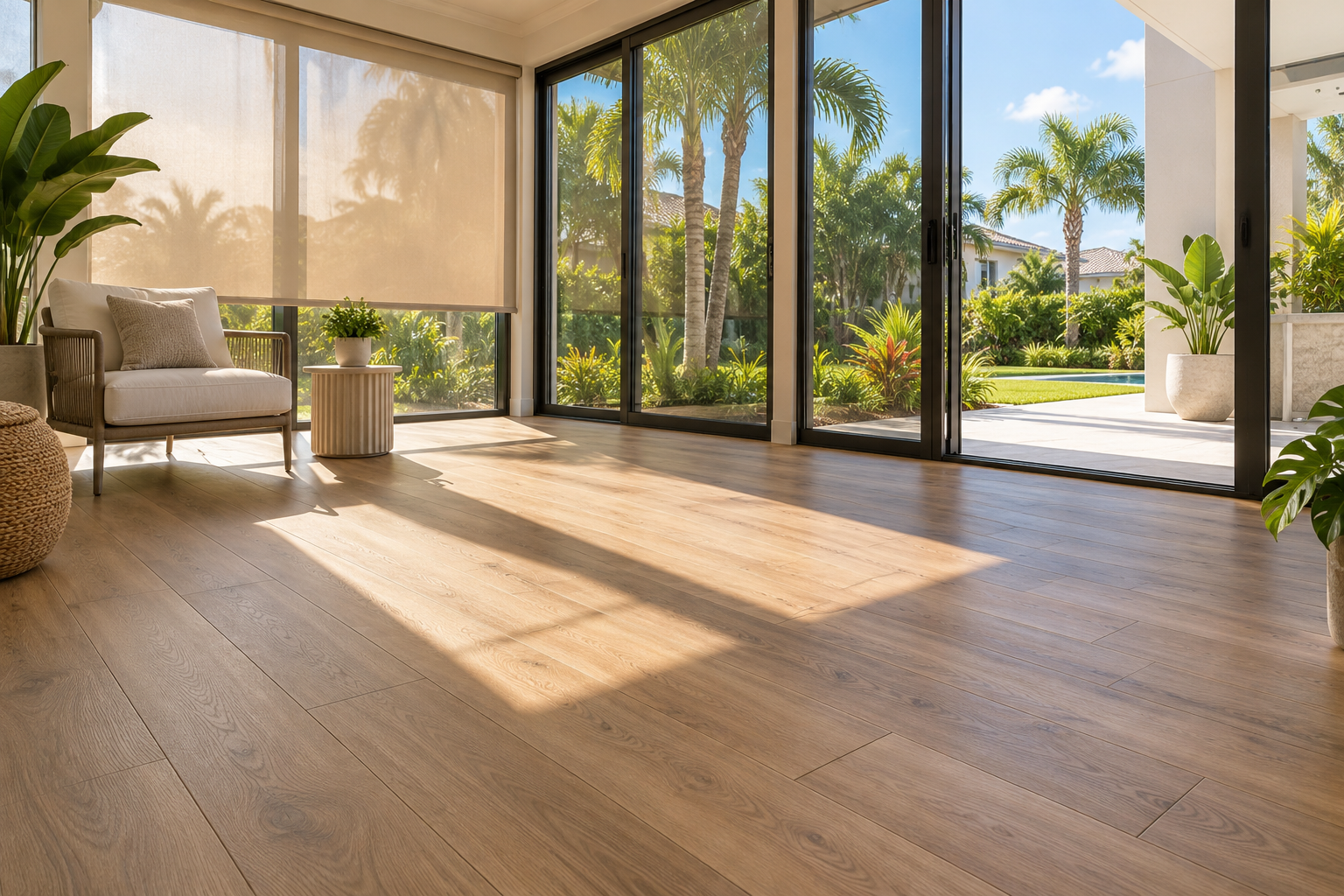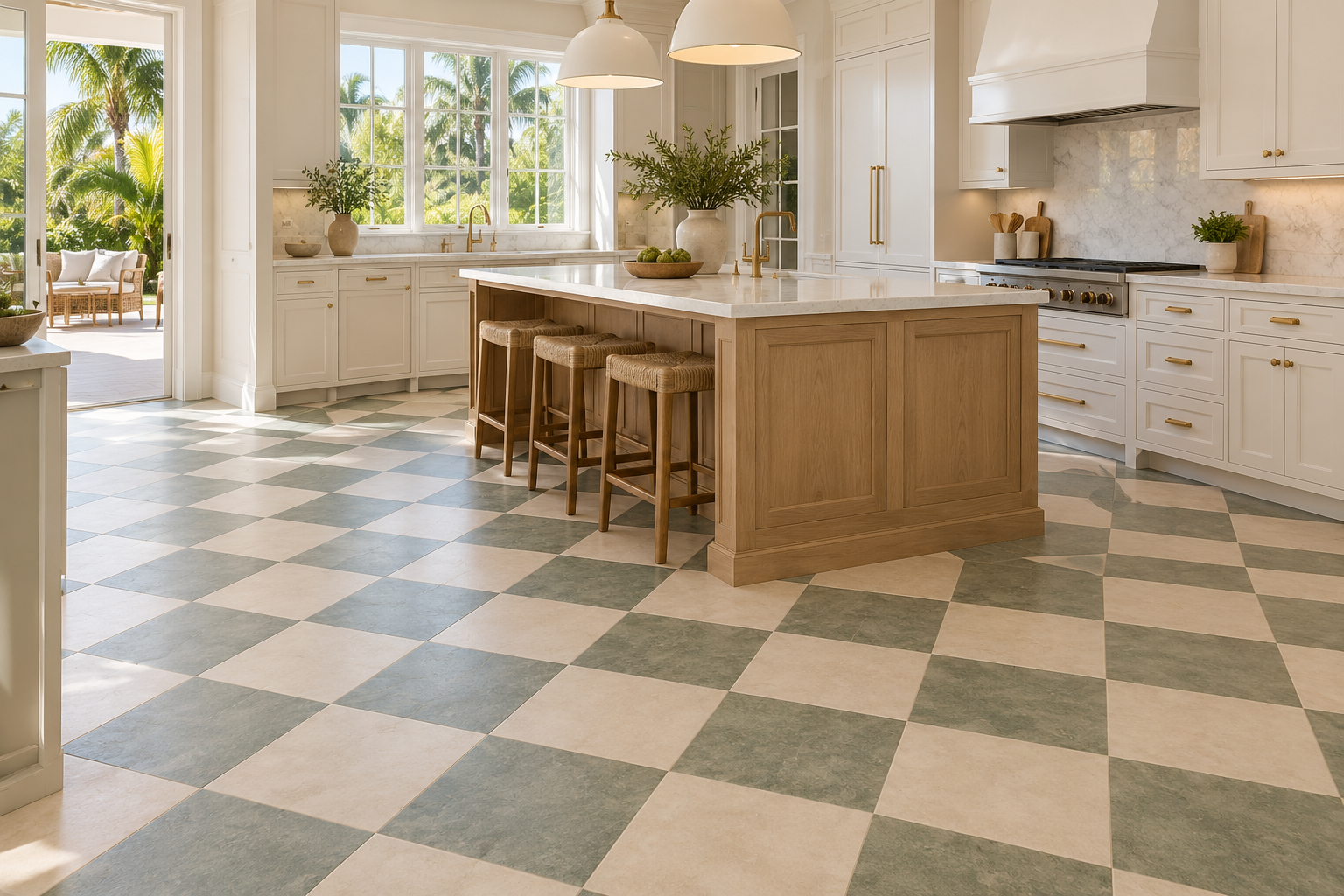
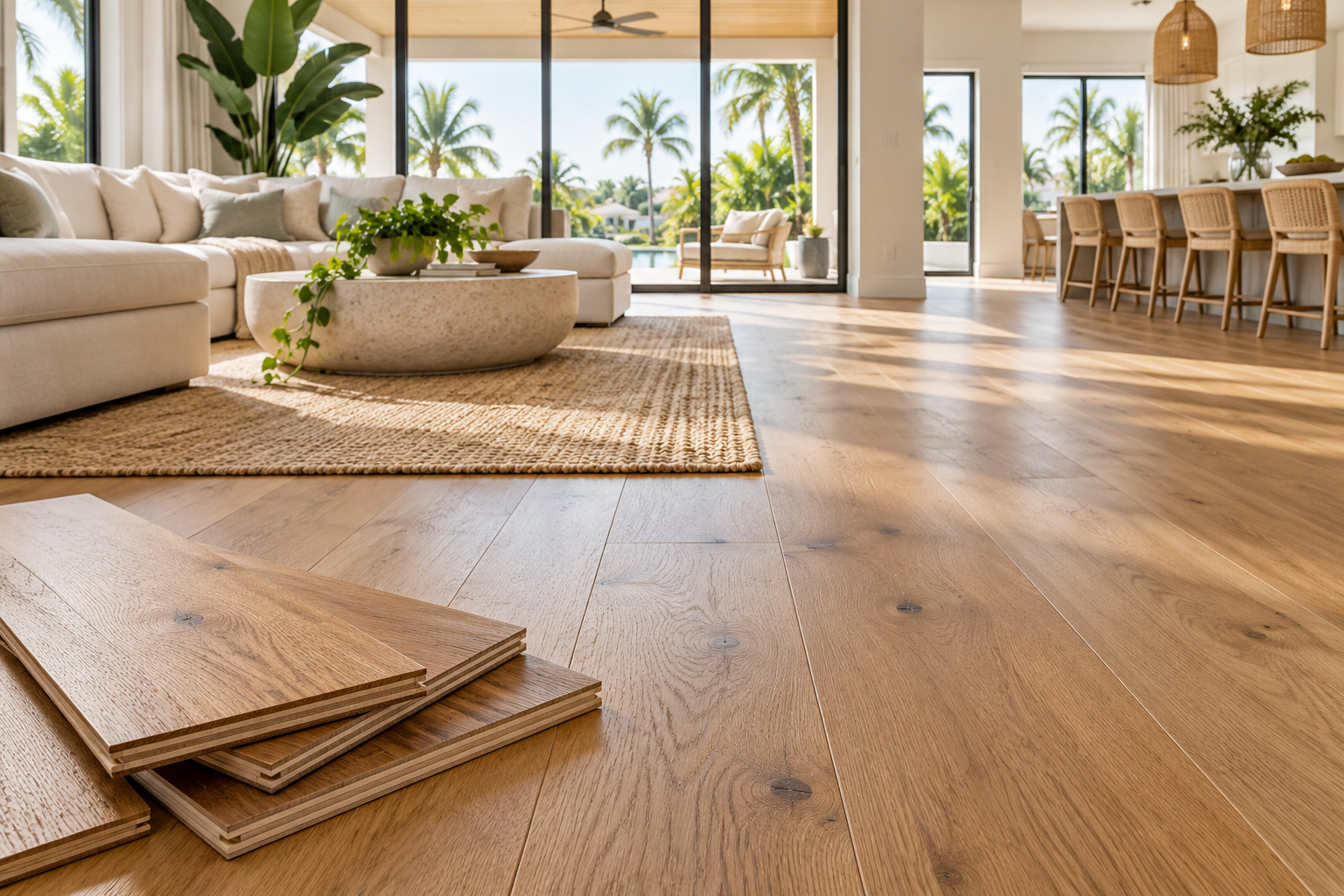
Wide-plank hardwood is having a major moment in Florida homes in 2026.
Homeowners are asking for wider boards, longer lengths, natural white-oak visuals, matte finishes and subtle wire-brushed textures that create a cleaner, more architectural look.
But in Florida, there is an important distinction:
Wide-plank solid hardwood and wide-plank engineered hardwood are not the same flooring system.
That matters because Florida homes deal with high humidity, concrete slabs, strong air-conditioning cycles and seasonal moisture changes that can create more movement in natural wood.
For many real-wood projects, engineered hardwood has become the more practical choice.
Why Wide-Plank Hardwood Is Trending in 2026
The move toward wider flooring is part of a larger design shift toward fewer seams, warmer natural tones and more realistic materials.
Seven-, eight- and nine-inch planks can make a room feel more expansive because the eye sees fewer board lines across the floor.
Popular looks include:
- Natural white oak
- European oak
- Warm honey and light caramel tones
- Low-sheen matte finishes
- Wire-brushed or lightly textured surfaces
- Long plank lengths with restrained natural variation
The overall goal is less “perfect showroom wood” and more authentic, natural character.
What Is Engineered Hardwood?
Engineered hardwood uses a real hardwood wear layer on top of a multi-layer core.
Depending on the product, that core may be made from plywood, hardwood layers or another engineered substrate.
The layered construction helps reduce the amount of dimensional movement compared with a single solid piece of wood.
That is the main reason engineered hardwood is often preferred in Florida.
Why Engineered Hardwood Handles Florida Better Than Solid Hardwood
Solid hardwood expands and contracts across the grain as indoor humidity changes.
Florida homes can experience a large difference between:
- Hot, humid outdoor air
- Cool, air-conditioned interiors
- Seasonal humidity changes
- Moisture coming through concrete slabs
Engineered hardwood is designed to be more dimensionally stable than solid wood because its layers are arranged to reduce movement.
That does not make engineered hardwood waterproof.
It simply means it is generally better suited to environments where moisture and humidity change than a comparable wide solid board.
Is 9-Inch Engineered Hardwood Too Wide for Florida?
Not automatically.
Wide planks can work very well in Florida when the product, installation method and indoor environment are appropriate.
The wider the board, however, the more important it becomes to control:
- Subfloor flatness
- Slab moisture
- Acclimation
- Indoor humidity
- Expansion space
- Adhesive coverage when glue-down is specified
Wide boards create a beautiful look, but they are less forgiving of installation shortcuts.
Why White Oak Is So Popular
White oak remains one of the strongest choices in wide-plank engineered flooring because it works with many current interior styles.
It pairs well with:
- Warm white cabinetry
- Organic modern interiors
- Coastal Florida design
- Transitional homes
- Contemporary kitchens
- Natural stone and terrazzo
White oak also accepts a wide range of stains, from pale natural finishes to richer honey and medium-brown tones.
Matte and Wire-Brushed Finishes Are Leading the Trend
High-gloss hardwood is less dominant than it was in previous decades.
Current engineered hardwood collections increasingly use matte, ultra-matte and wire-brushed finishes.
These finishes can help:
- Reduce glare in bright Florida homes
- Make the grain feel more natural
- Disguise minor surface wear
- Show less dust than very dark glossy finishes
Can Engineered Hardwood Be Installed Over a Florida Concrete Slab?
Yes, and that is one of its biggest advantages.
Many Florida homes are built on concrete slabs, and engineered hardwood can often be installed over properly prepared concrete using an approved glue-down or floating system.
But slab preparation is critical.
Before installation, the contractor should evaluate:
- Moisture
- Flatness
- Cracks
- Contaminants
- Previous adhesives or coatings
The flooring manufacturer’s moisture limits and installation requirements should always control the final system.
Why Moisture Testing Still Matters
Engineered hardwood is more stable than solid hardwood, but it is still real wood.
Installing it over a wet slab can lead to:
- Cupping
- Swelling
- Adhesive failure
- Discoloration
- Mold beneath the floor
- Warranty problems
Moisture testing should be part of the installation process, not an optional upgrade.
Glue-Down vs. Floating Engineered Hardwood
Glue-Down
Glue-down installation is common over concrete slabs.
Advantages can include:
- More solid feel underfoot
- Less hollow sound
- Good dimensional control
- Lower finished-floor height in some systems
The adhesive must be compatible with the flooring, slab and moisture conditions.
Floating
Some engineered hardwood products can be installed as floating floors.
This method can simplify installation and may allow the use of acoustic underlayment.
However, floating systems still require proper expansion space, flat subfloors and approved environmental conditions.
What Is a Wear Layer?
The wear layer is the real hardwood layer at the top of the engineered plank.
Its thickness affects:
- How much real wood is present
- Whether the floor may be refinished later
- Long-term serviceability
A thin veneer may allow limited or no sanding.
A thicker wear layer may allow professional refinishing, depending on the product and construction.
How Thick Should the Wear Layer Be?
There is no single correct number for every project.
For homeowners who want the possibility of future refinishing, a thicker wear layer is generally more desirable.
When comparing products, do not look only at total plank thickness. Ask specifically about:
- Wear-layer thickness
- Core construction
- Number of plies
- Refinishing guidance
- Manufacturer warranty
Plywood Core vs. HDF Core
Engineered hardwood can use different core structures.
Multi-ply plywood cores are common in premium products because the cross-layer construction provides dimensional stability.
Some products use HDF or other engineered cores.
Neither category should be judged by one label alone. The complete product specification, moisture requirements, installation method and warranty matter more than a single marketing term.
Does Engineered Hardwood Need to Acclimate in Florida?
Often yes, but the correct acclimation procedure depends on the manufacturer.
The goal is to bring the flooring and jobsite into the environmental conditions required for installation.
That means the HVAC system should usually be operating and the home should be at normal living conditions before installation begins.
Never assume that every engineered hardwood requires exactly the same number of acclimation hours.
What Indoor Humidity Is Best?
Real wood performs best when the home remains within the manufacturer’s recommended temperature and relative-humidity range.
In Florida, consistent air-conditioning and humidity control are important.
Large swings between very humid and very dry indoor conditions can increase seasonal expansion and contraction.
Is Engineered Hardwood Waterproof?
No.
This is one of the most important distinctions for Florida homeowners.
Engineered hardwood may tolerate normal humidity better than solid hardwood, but it is still a wood product.
Standing water, plumbing leaks, repeated pet accidents or floodwater can damage it.
If the project requires true waterproof performance, SPC, LVP or porcelain may be the better choice.
Can Engineered Hardwood Go in a Florida Kitchen?
Yes, many homeowners use engineered hardwood in kitchens.
However, leaks should be cleaned quickly and appliances should be monitored carefully.
Homeowners who want maximum protection from water may prefer resilient flooring or porcelain instead.
What About Bathrooms and Laundry Rooms?
These spaces generally involve greater water risk.
Unless the manufacturer specifically approves the product and installation for that environment, porcelain or waterproof resilient flooring is often a more practical choice.
Can Engineered Hardwood Be Used on a Screened Porch?
Usually not unless the exact manufacturer explicitly approves the application.
Most engineered hardwood is designed for conditioned interior spaces.
A screened lanai or porch can experience:
- High humidity
- Wind-driven rain
- Heat
- Temperature swings
Exterior-rated porcelain is generally more appropriate for those environments.
Is Engineered Hardwood Good for Pets?
It can be, but real wood can scratch.
Pet owners should consider:
- Wood hardness
- Finish durability
- Surface texture
- Pet size
- Nail maintenance
Matte and wire-brushed finishes can help disguise minor wear better than highly polished surfaces.
Can Engineered Hardwood Be Refinished?
Some engineered hardwood can be refinished and some cannot.
The answer depends largely on the thickness of the real-wood wear layer and the construction of the plank.
Always verify the manufacturer’s guidance before assuming a floor can be sanded.
Engineered Hardwood vs. LVP in Florida
Both can be excellent choices, but they solve different problems.
Engineered hardwood may be better when:
- You want authentic real wood
- Natural variation matters
- You value the possibility of refinishing
- The space is climate controlled
- Water exposure is limited
LVP or SPC may be better when:
- Waterproof performance is a priority
- The home has pets or heavy traffic
- You want lower maintenance
- The project includes kitchens, laundry or moisture-prone areas
Engineered Hardwood vs. Porcelain
Porcelain offers superior water resistance and can be used in more wet or exterior-adjacent applications.
Engineered hardwood provides the warmth, feel and authenticity of real wood.
The better choice depends on where the flooring is going and how the home is used.
What Should You Ask Before Buying Wide-Plank Engineered Hardwood?
- What is the wear-layer thickness?
- What is the core construction?
- Is the product approved for concrete slabs?
- What moisture limits apply?
- Is glue-down or floating installation recommended?
- What indoor humidity range does the manufacturer require?
- Can the product be refinished?
- What spaces are excluded from the warranty?
- Does the manufacturer allow 7-, 8- or 9-inch widths in the intended installation?
Final Thought
Wide-plank engineered hardwood is trending because it combines two things homeowners increasingly want: authentic real wood and a cleaner, more modern scale.
For Florida homes, engineered construction can provide better dimensional stability than comparable solid hardwood, especially over concrete slabs and in conditioned interiors.
But it is still real wood.
That means moisture testing, humidity control, proper installation and realistic expectations remain essential.
At Green House Floors and More, we believe wide-plank hardwood should be selected based on both design and the real conditions of the Florida property.
Frequently Asked Questions
Is engineered hardwood good for Florida?
Yes. Engineered hardwood is often better suited to Florida than solid hardwood because its layered construction provides greater dimensional stability. It still requires moisture control and proper installation.
Is 9-inch engineered hardwood too wide for Florida humidity?
Not necessarily. Wide planks can perform well when the product is designed for the application, the subfloor is prepared correctly and indoor humidity remains within the manufacturer’s required range.
Can engineered hardwood go over a concrete slab?
Yes. Many engineered hardwood products can be glued down or floated over properly prepared concrete slabs, subject to the manufacturer’s moisture requirements.
Is engineered hardwood waterproof?
No. Engineered hardwood is more dimensionally stable than solid wood, but it is still a real-wood product and can be damaged by standing water or flooding.
What wood species is popular for Florida homes?
White oak and European oak are especially popular because of their natural grain, warm neutral tones and compatibility with contemporary Florida interiors.
How thick should the wear layer be?
The ideal thickness depends on budget and long-term expectations. A thicker real-wood wear layer generally offers more future refinishing potential.
Can engineered hardwood be refinished?
Some products can be professionally refinished if the wear layer is thick enough. Thin-veneer products may have limited or no refinishing capability.
Is engineered hardwood better than LVP in Florida?
It depends on the project. Engineered hardwood provides authentic real wood, while LVP and SPC generally provide better waterproof performance and easier maintenance.